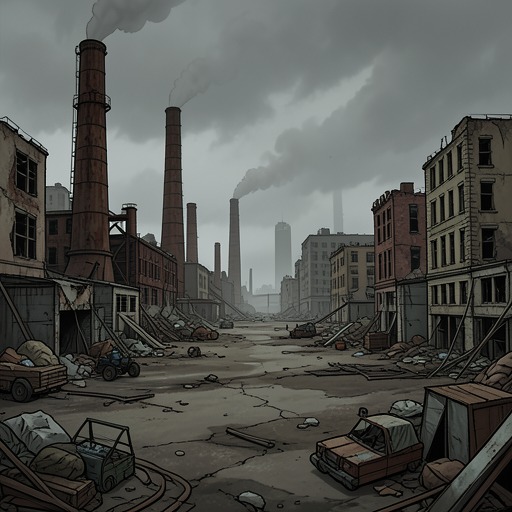
South Chicago’s deindustrialization and mass unemployment
Blood ShotSouth Chicago’s deindustrialization and mass unemployment form a social and environmental condition rather than a single turning point. The neighborhood’s closed or diminished industrial employers leave a landscape marked by vacant plants and polluted land, while residents contend with lost work and weakened prospects. The novel sets that change against memories of a time when industrial employment supported households across the area, then follows its consequences into community politics, environmental proposals, and disputes over workers’ health.
Industrial Expansion and Retreat
The decline is measured against a history of large-scale industrial expansion. For more than a century, engineers and industrialists transformed marshland between Lake Calumet and Lake Michigan into the Calumet Industrial District. The land was filled with dredged clay and a range of industrial materials. The resulting district was not a natural landscape subsequently touched by industry: its ground had been remade to serve an industrial economy, with pollution embedded in that transformation.
At the neighborhood level, the former scale of employment is recalled through the daily movement of eighteen thousand men from their homes to the South Works, Wisconsin Steel, the Ford assembly plant, and the Xerxes plant. That memory includes the relative security of regular industrial wages: household exteriors were maintained, and new cars were a familiar annual purchase. The recollection is explicitly bound to a past life, not offered as a promise that prosperity can simply be restored. By the time the narrator returns, the South Works is on strike and Wisconsin Steel is padlocked and rusting. The contrast makes deindustrialization visible in both disrupted work and the changed condition of the places that once provided it.
Household Hardship and Community Memory
The neighborhood’s decline appears in damaged or aging houses, but not as a picture of complete surrender. Some bungalows have missing siding, peeling paint, or cracked and sagging steps; their windows remain intact and their yards clear of debris. The careful upkeep complicates any simple equation between poverty and neglect. The residents’ refusal to let their homes fall into disrepair becomes a quiet counterpoint to the deterioration of the industrial landscape around them.
The commercial streets register economic and demographic change differently. Many stores now have Spanish names, while their displays and buildings seem little changed from the narrator’s childhood. At the same time, mass unemployment in the mills has increased the number of men without work around the neighborhood’s taverns. During conversation about the current basketball team, the neighborhood’s unemployment is described as reaching roughly fifty percent. The figure connects the area’s broader economic condition to an ordinary social gathering, rather than isolating it as a distant statistic.
The return also exposes the distance between remembered community and present conditions. The Calumet River, where local children once swam, is now understood as polluted. The industrial district around Lake Calumet appears stripped of the signs of ordinary living things. These changes do not replace one another neatly: economic retreat has not undone industrial contamination. The community inherits the environmental costs of the industrial landscape even as the jobs associated with it disappear.
Work, Pollution, and Unequal Risk
The novel links job loss to continuing workplace and environmental hazards. Workers at the Xerxes plant sought compensation after becoming ill and suspected exposure to Xerxine. Their case failed after Humboldt Chemical argued that smoking and other pollution made causation impossible to establish, and that exposure had occurred before the chemical’s toxicity was known. The result illustrates how the industrial past can remain consequential after workers have left or lost the jobs: illness persists, but legal standards and the difficulty of proving a specific cause restrict access to compensation.
That evidentiary problem is especially stark in a place where industrial contamination is not limited to a single employer. The long history of the Calumet Industrial District and the polluted air associated with South Chicago furnish alternative explanations that companies can invoke against claims tied to a particular substance. In the workers’ compensation case brought by Pankowski and Ferraro, those competing causes helped defeat the claim. The novel therefore presents environmental damage not only as a physical burden but also as a complication in deciding who is responsible for workers’ illnesses.
Local Politics and the Search for New Work
The proposed solvent-recycling plant offers a possible response to both unemployment and pollution. Caroline Djiak explains that the project has funding, a site, and specifications that have passed the environmental tests considered by its proponents. It could bring about a hundred jobs to the area and reduce the amount of waste entering the ground. The proposal makes recovery from deindustrialization a practical question: new employment is linked to addressing the contamination left by the old economy.
The project’s supporters nevertheless fail to secure a hearing. Nancy Cleghorn recounts that the proposal was kept off the agenda despite having been filed in time, and that the stated objection shifted to an alleged lack of full community support. She says she was prepared to produce petitions, but the board chairman maintained that some residents opposed the plan. Caroline connects the decision to the zoning board chairman’s ties to established ward politicians. The episode shows that a project promising jobs and pollution reduction still depends on access to local decision-making; community backing alone does not guarantee that a proposal will be heard.
The political and commercial networks surrounding the old industrial economy remain visible in the ward office on Avenue M. Its sign still identifies Art Jurshak as alderman and Freddy Parma as ward committeeman, and the neighboring insurance agency had helped Jurshak establish a foothold in the community. A 1963 letter in Nancy’s files identifies Jurshak & Parma as fiduciaries for the Xerxes plant and includes an actuarial study seeking favorable rate consideration from Mariners Rest Life Assurance Company. Later, the directors list for Ironworkers Savings & Loan includes Gustav Humboldt, who has retained his board position since the 1940s despite his company’s growth and his other corporate directorships. These details place local political standing, insurance work, and industrial authority within overlapping institutions, without making those connections a substitute for evidence about any individual decision.
Narrative Significance
South Chicago’s decline is presented through juxtaposition: remembered industrial employment beside shuttered workplaces, households maintained amid poverty, and proposals for new jobs obstructed while pollution remains. The old economy has receded without releasing the community from its environmental and health consequences. Workers’ claims are weakened by the very breadth of contamination that defines the district, while efforts to create cleaner employment encounter political barriers. Deindustrialization thus shapes more than the setting. It determines what forms of work remain imaginable, whose account of risk can be established, and how difficult it is for residents to influence decisions about their own surroundings.